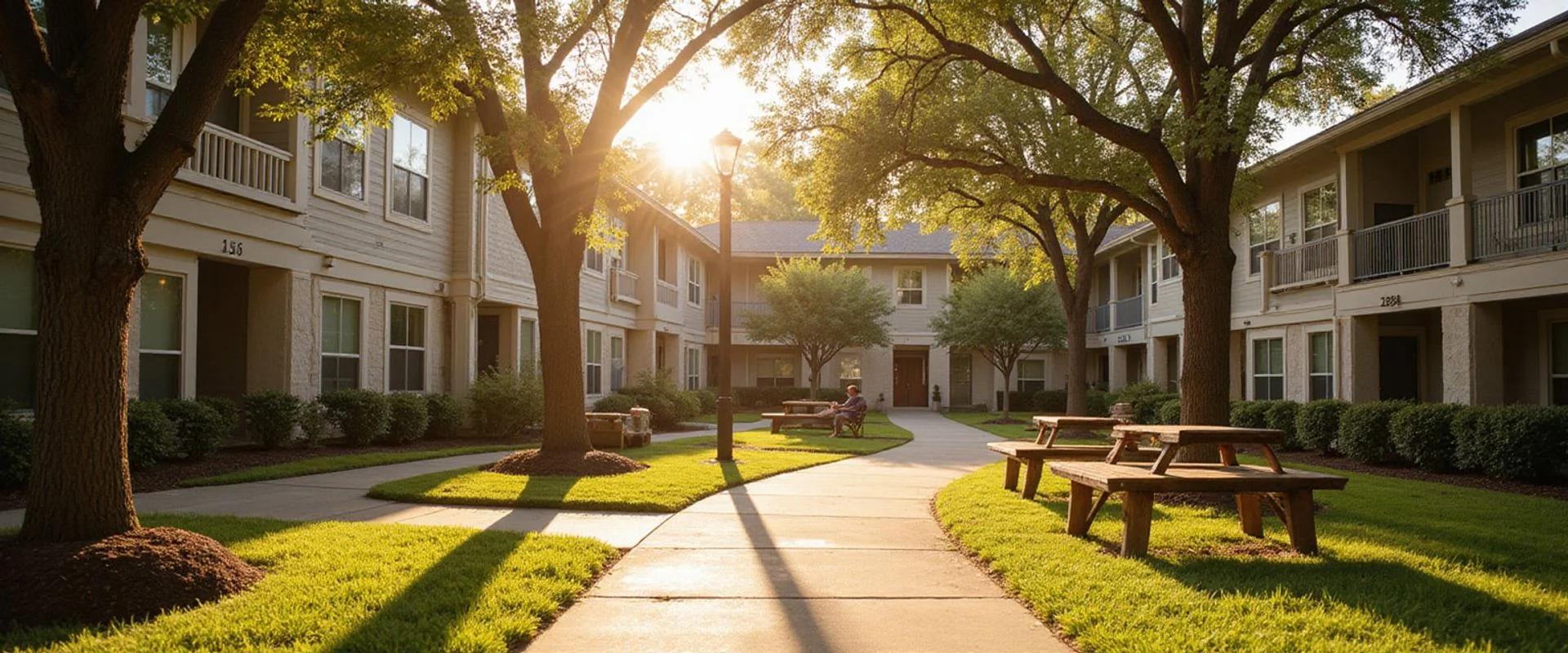
A 55+ community is an apartment community that limits who can live there by age. If you’re 55 or older, you can usually live in one, and each community decides how it treats younger spouses, partners and caregivers. Houston Apartment Locators Group is a free apartment locator for Houston and the Harris County metro, licensed under Spirit Real Estate Group, LLC (TREC #9003398). Send us your budget, move date and the parts of Houston you like, and we build a custom list of senior living apartments around them, usually within a business day.
Many people reading this are downsizing from a house or helping a parent find a place. Both go better with clear facts and fewer surprises. This page covers the age rule, how 55+ apartments compare with independent living and assisted living, what to ask on a tour, and how to time a move out of a house.
What is the 80/20 rule for 55+ communities?
The federal Housing for Older Persons Act (HOPA) allows a community to limit residency by age and still follow fair housing law. HUD publishes the rules. Here is what they mean in practice.
- 55+ communities. At least one resident must be 55 or older in at least 80% of the occupied units. The community must publish and follow an age policy that shows it intends to operate as a 55+ community.
- 62+ communities. Every resident must be 62 or older.
That 80% figure is why this is often called the 80/20 rule, and it’s the reason a younger spouse, partner or adult child can sometimes live in a 55+ community. It’s also the reason the answer is not the same everywhere. Each community sets its own rules for younger spouses, partners, caregivers and visiting grandchildren. Ask for the policy in writing, and ask how it applies to your household before you pay an application fee.
Here is a simple way to use this. Before you tour, write down everyone who would live in the apartment, their ages, and anyone who would stay for long stretches, such as a caregiver or an adult child between jobs. Hand that list to the leasing office and ask how the policy applies. A clear answer in writing beats a verbal yes at the front desk.
If you want the source, search HUD’s guidance on the Housing for Older Persons Act. It is short and readable.
Senior apartments vs independent and assisted living
People often mix up four kinds of senior housing. They are different products with different contracts. We help with apartments, not care facilities.
| 55+ apartments | Regular apartments | Independent living | Assisted living | |
|---|---|---|---|---|
| What it is | An apartment community with an age rule | An apartment community with no age rule | A community for older adults that often bundles services | A residence that provides help with daily needs |
| What is included | The apartment, community amenities and sometimes resident services such as social events | The apartment and community amenities | Varies by community, often meals, housekeeping or activities | Housing plus care services |
| Care level | None provided | None provided | Typically little to none | Care services provided |
| Typical contract | A standard apartment lease | A standard apartment lease | Varies by community | Varies by facility and care plan |
| Do we help? | Yes | Yes | No | No |
If you need care, talk with your doctor or a care planner. We are apartment locators. A 55+ apartment is a lease, the same way any other apartment is a lease, with an age rule on top. Many Texas communities use the Texas Apartment Association (TAA) lease form, so the terms will look familiar if you’ve rented here before.
A 55+ community is also not your only apartment option. Some people prefer a regular apartment community for its location, price or floor plan. We build lists with both kinds when that fits your search.
The same questions apply to all of them. Whatever the age rule, you are signing a lease. Read the term, the fees, the renewal terms and the move-out rules before you apply, and ask the community to put anything unclear in writing.
Your tour checklist for the leasing office
Take this list with you. The answers decide whether an apartment works for you for years, not just this lease.
- Elevator or walk-up? Many Houston garden-style communities are two or three stories with no elevator, while mid-rise buildings usually have one. If there is no elevator, ask which floors are walk-up only.
- Ground-floor availability. Ask how often ground-floor units open up and whether there is a waitlist.
- Bathroom setup. Ask about grab bars, walk-in showers and whether you may add them.
- Parking near the door. Ask about reserved or covered spots and the walk from the car to your unit.
- Guest and caregiver rules. Ask how long a guest can stay and whether a caregiver can stay overnight.
- Pet rules. Breed, weight and fee rules vary. See our pet-friendly apartments page.
- Activities and resident services. Ask which senior community events and services are free and which carry a fee.
- Utilities. Ask what is included and whether there is a cap.
- Lease length and renewal increases. Ask for the renewal terms. Our guide on what happens to your rent at renewal explains why a low first-year rent can reset higher in year two.
- If you need to move to care. Ask what happens to your lease if a resident later needs a different kind of housing, and what it costs to end the lease early.
Write the answers down at each stop. After three tours the details blur together.
Questions about cost and the lease
Rent is only one line. Ask for the application fee per adult, the administrative fee, the security deposit and any monthly charges for trash, pest control or amenities. Ask whether renters insurance is required. Our guide on renters insurance for a Houston apartment covers what to compare. Then ask for the screening criteria in writing. Here is how to get screening criteria in writing.
Questions about daily life
Walk the route from the parking spot to the mailbox, the trash room and the front door of your unit. Look at how far the laundry room is, if the community has one. Check the lighting in the hallways. Ask how maintenance requests are handled and how quickly the office answers the phone. These details do not show up in a listing, and they shape how the apartment feels month after month.
Income-restricted senior living apartments in Houston
Some 55+ communities are tax credit properties with income limits. That means your household income must fall under a cap to qualify, and the rent is set to match. The caps depend on the program, the year and household size, so we do not quote a number here without a source. Ask the community which program it uses and which year’s limits apply to your household.
In Houston, most income-restricted senior housing comes through three programs. Low-Income Housing Tax Credit (LIHTC) properties are awarded through the Texas Department of Housing and Community Affairs (TDHCA), and some reserve their units for residents 55+ or 62+. HUD’s Section 202 program funds housing for very low-income households age 62 and older. Housing Choice Vouchers come through the Houston Housing Authority or the Harris County Housing Authority and can be used at properties that accept them. Our Section 8 apartments page covers how vouchers work.
If your budget is tight, read our low income apartments page for how income limits, rent caps and paperwork work. We can tell you which income-restricted options exist when we build your list.
Downsizing from a house to an apartment
Leaving a house is more than finding an apartment. A few things help.
- Time the sale with the lease start. If you sell first, you may need a short gap. If you lease first, you may pay rent and a mortgage for a month or two. Ask each community about lease start dates and whether a shorter first term is possible.
- Plan for storage. Apartments hold less than houses. Decide what moves, what goes to storage and what leaves before the lease starts. Ask whether the community offers storage and what it costs.
- Measure before you move. Check doorways, closets and kitchen space against your furniture.
- Count the one-time costs. Application fees, administrative fees and the security deposit arrive before your first rent payment.
- Ask about the move itself. Some communities reserve an elevator for move-in day or limit move-in hours. Ask early so the movers know what to expect.
Take the process in order. Start the search a couple of months before you need the keys, tour a few places, and only then decide how to handle the sale of the house. Rushing the apartment choice to fit a closing date is how people end up in a place that does not suit them.
If a family member is handling part of the search from another city, we can help with that too. Read about our sight-unseen relocation help and our moving concierge service.
Where to find 55+ communities around Houston
55+ communities are spread across the Houston area, from Inside the Loop near the Texas Medical Center to suburbs past Beltway 8 such as Sugar Land, Pearland, Katy and The Woodlands. The right part of town depends on your budget, how close you want to be to family and your daily routine. We do not rank areas. Searching for 55+ apartments near you? Browse our service areas to see the parts of Houston we cover, then tell us which ones interest you and we will check what is current.
How our free locator service works
- Houston Apartment Locators Group is free to renters. The property pays us a small referral fee after you sign a lease.
- We are licensed Texas agents with Spirit Real Estate Group, LLC, TREC #9003398.
- We talk with communities every day and track their screening criteria. Some screen in house and can make exceptions. Many use third-party screeners, such as SafeRent or TransUnion SmartMove, that cannot.
- We send a custom list, usually within a business day.
- We help with tours and applications, even if you can’t get ahold of the community.
Each property sets its own screening criteria and makes every approval decision. Availability, pricing and specials can change without notice.