
There is no single Houston number
Anyone who tells you “you need a 620 in Houston” is guessing. Score thresholds are set property by property, and they cluster by building class rather than by city.
That’s actually good news, because it means the question isn’t “do I qualify” but “which stock do I target.” Getting that right before you spend an application fee is the whole job — it’s the core of what we do on second chance leasing.
How class shapes the threshold
Property class describes age, finish level, and amenity package, and it correlates closely with how screening runs.
Class A — newer construction, full amenity decks, corporate-managed. These run the firmest criteria and the least on-site discretion. Screening is often centralised, decisions are automated against a scorecard, and a marginal file gets a conditional approval with an additional deposit or a decline.
Class B — typically 1980s–2000s stock, solid but not new. Mixed management: some corporate, plenty of regional and local operators. This is where discretion starts to appear and where a good explanation plus documentation can move a decision.
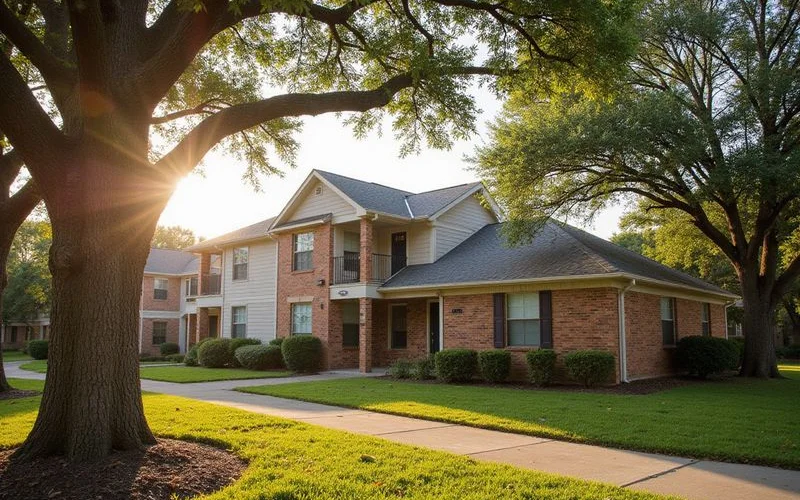
Class C — older stock, often pre-1990, disproportionately locally owned or run by smaller firms. On-site managers frequently hold real approval authority, and the whole file gets read rather than a single number checked.
Houston’s inventory skews toward the flexible end more than most large metros. Roughly 20% of units were built 1970–1979 and 16% in 1980–1989, so more than a third predates 1990. With 58% of Houston households renting, the volume of case-by-case stock here is genuinely large.
What’s on the report matters more than the number
Two applicants with identical scores get different outcomes constantly, because underwriting reads the composition.
Rental collections are the heaviest item almost everywhere. A balance owed to a prior landlord is directly predictive of the risk the property cares about, and many criteria treat it separately from general credit.
Charge-offs from consumer credit weigh less, but recency matters — a charge-off from last quarter reads differently to one from four years ago.
Medical collections are usually the lightest-weighted category and are excluded from some scoring models entirely.
Utility collections sit in between, and in a deregulated electricity market like Houston’s they show up more often than you’d expect.
A thin file is not a bad file. If your score is low because you have almost no history, that’s a different problem with different solutions — see renting with no credit file.
The score you see may not be the score they see
Most properties use a tenant-screening product rather than a raw consumer score, and the underlying model may be FICO or VantageScore. A free credit app can differ by 30 points or more from what the property pulls. Don’t build a plan on a number you haven’t confirmed.
Conditional approvals
The most common outcome for a marginal file isn’t a decline, it’s a condition. Typically one of:
| Condition | What it means |
|---|---|
| Additional deposit | Often one extra month, refundable |
| Guarantor required | Someone qualified stands behind the lease |
| Deposit alternative | A non-refundable fee replacing part of the deposit |
| Higher income multiplier | 3.5x instead of 3x on the same unit |
Worth knowing before you apply, because “approved with conditions” changes your move-in cost by hundreds or thousands of dollars. Ask what the conditional path looks like at the same time you ask about the threshold.
What to do with all this
Check your own report first so the number you’re planning around is real. Ask for the property’s published criteria in writing rather than for an opinion. Then target the class of stock where your file has a realistic chance, instead of applying broadly and paying for the education.
We state property criteria factually and with a date, and we don’t guarantee approval — anyone who does is bluffing. What we do is confirm the criteria before you spend anything, so you know where you stand before you apply.